

Early orthodontic treatment addresses selected bite and jaw-development problems before all permanent teeth arrive. For some children, that means creating room in a narrow upper jaw. For others, the right next step is monitoring growth.
At Peak Family Dentistry, Dr. Billie Adams evaluates children’s arch development as part of the practice’s airway-focused dental care. Start with an evaluation to discuss your child’s bite, growth, and treatment options.
The American Association of Orthodontists recommends a first orthodontic check by age seven. An earlier visit is appropriate when a parent or dentist notices a developing problem. The recommendation is for an evaluation—not automatic braces or an expander. See the AAO’s age-seven guidance.
A child may have a mix of baby and permanent teeth at that visit. An evaluation can help identify concerns that deserve attention during growth and those that can be watched until later.
These signs call for assessment; they do not identify the right appliance on their own. AAO guidance on early treatment
A dental arch is the curved arrangement of teeth in each jaw. Arch development describes how that space and shape change as a child grows. Treatment planning considers tooth size, available space, jaw relationships, and the way teeth are coming in.
Arch development is not a single appliance or a reason to expand every child’s mouth. A narrow upper jaw, a tooth-position problem, and space lost after early tooth loss can require different approaches. The AAPD’s guidance on developing teeth and bites emphasizes diagnosis and timing before selecting treatment.
| Finding | Possible next step |
|---|---|
| A narrow upper jaw contributing to a crossbite | Evaluate whether palatal expansion would address the width problem. |
| Space lost after a baby tooth comes out early | Assess whether space maintenance or space regaining is appropriate. |
| A developing alignment concern without a reason to intervene now | Monitor eruption and growth; reconsider treatment at a later visit. |
These are examples of clinical decisions, not a diagnosis or a list of appliances every child will need.
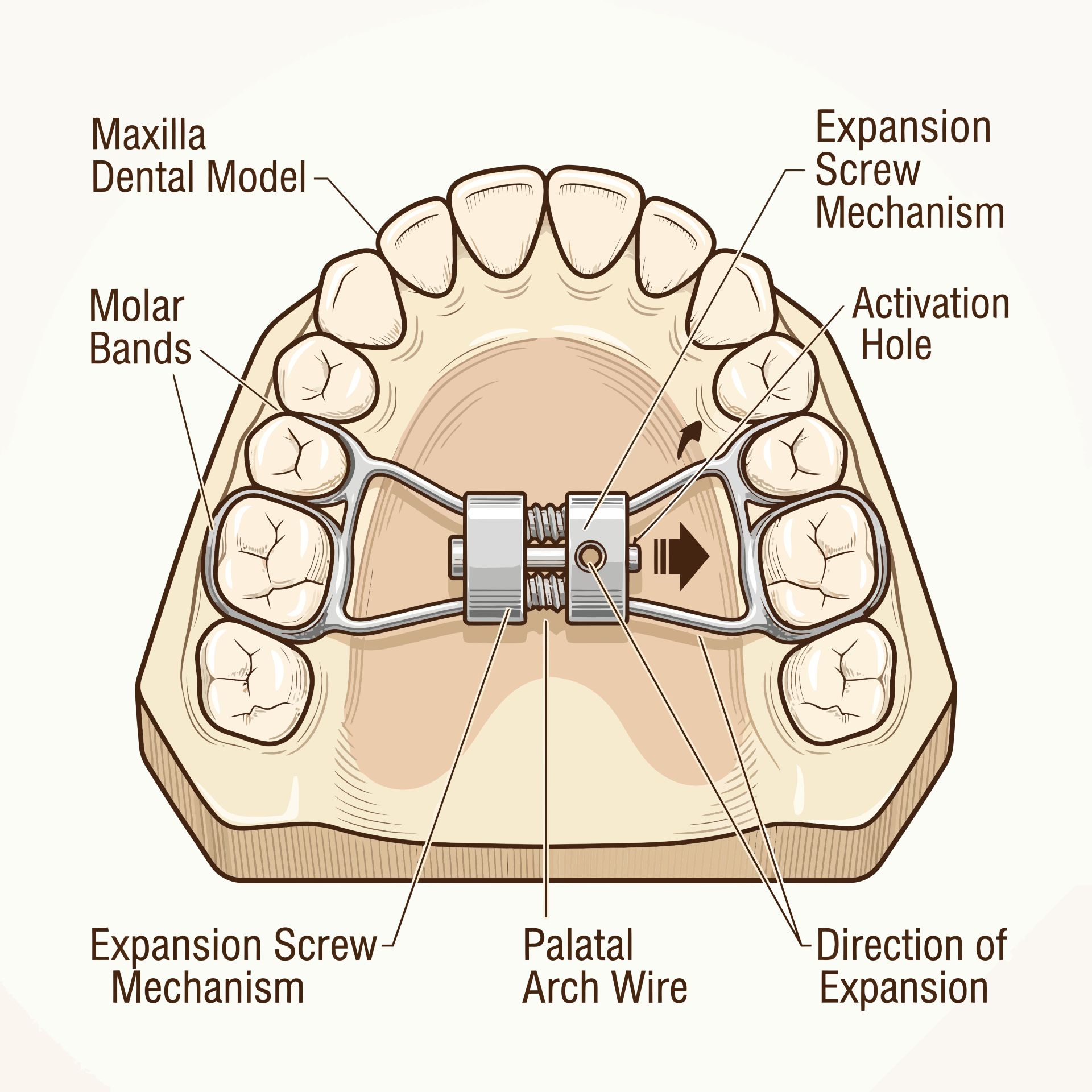
A palatal expander widens a narrow upper jaw. An expander may help correct a width-related crossbite and create space for permanent teeth. The palate is the roof of the mouth; expanding the upper jaw is different from moving individual teeth with braces.
Suitability depends on the child’s anatomy, growth, and bite. A birthday alone cannot determine whether a seven-year-old needs an expander or whether a twelve-year-old is too old. Fixed and removable designs exist; the clinician selects an appropriate approach.
Source: AAO: What is a palatal expander?
Pressure, mild tenderness, and temporary speech changes can occur while a child adjusts. Softer foods may be easier initially. Careful cleaning and avoiding foods that could damage the appliance matter. Contact the treating office about severe or persistent discomfort.
Active expansion and the period that holds the result are separate stages. The schedule varies. Follow the treating clinician’s instructions for adjustments and checkups; do not use an online turning schedule.
Phase 1, also called interceptive orthodontics, targets a specific concern while a child is developing. Phase 2 generally addresses overall alignment and the bite after more permanent teeth arrive. Some children have an observation period between phases; others need only one comprehensive phase.
An early appliance is not a promise that a child will avoid future braces, extractions, or other treatment. Ask what the first phase is intended to accomplish and what may still be needed afterward. The AAO explains the difference between Phase 1 and Phase 2.
Frequent snoring, ongoing mouth breathing, or witnessed pauses in breathing during sleep deserve attention. Tell your child’s dentist and pediatrician about these symptoms. A dental evaluation can identify concerns, but it does not replace a medical assessment for obstructive sleep apnea.
Breathing problems can involve enlarged tonsils or adenoids, nasal obstruction, and other factors. An expander does not address every cause. Orthodontic treatment may be considered for selected children as part of coordinated care; it should not be presented as a guaranteed cure for sleep apnea.
The AAPD’s policy on pediatric obstructive sleep apnea recommends medical referral when sleep apnea is suspected and notes limitations in the evidence for expansion as an airway treatment.
Peak’s pediatric airway management services address children’s breathing-related concerns. The broader airway orthodontics page explains the practice’s approach for children and adults.
A useful consultation should leave you understanding the concern, the reason for the recommended timing, and the alternatives. Meet Dr. Billie Adams and bring questions about your child’s teeth, habits, chewing, or sleep.
A clinical assessment considers dental and medical history, the bite, tooth eruption, and growth. Photos, models or scans, and X-rays may be recommended when needed for diagnosis. The findings help determine whether treatment, monitoring, or a specialist referral is appropriate. AAPD assessment guidance
There is no single fee that fits every child’s plan. Request a written estimate that identifies the appliance, records, follow-up visits, retention, and any later phase billed separately.
Ask the office and your insurer whether your child’s plan includes orthodontic benefits, age restrictions, or a lifetime maximum. A consultation is the place to clarify coverage and out-of-pocket costs before committing to care.
Tell us what you have noticed and what you would like to understand. Request a visit at our Albuquerque dental office to discuss early orthodontics and arch development with Dr. Adams.
Contact Us Today
Dr. Adams and the staff of Peak Family Dentistry are here to help patients in Albuquerque, NM, experience the benefits of great health and beautiful smiles. We treat you like a member of our family. Your voice matters, your presence is welcome, and we are always glad to hear from you.
At Peak Family Dentistry, we perform many general, restorative, and cosmetic dentistry procedures, with a focus on comprehensive health. This includes advanced teeth whitening for stains and dental implants for missing teeth. We also offer sleep dentistry services for people suffering from sleep apnea. Every procedure is performed by a team that cares immensely about each guest who visits our office.
For more information about state-of-the-art restorative and cosmetic dentistry, request a consultation with Dr. Adams.
You can also reach us by phone at:
(505) 293-2211