
Peak Family Dentistry • Patient Education
A palate expander widens a narrow upper jaw. Braces move teeth to improve their alignment and how they meet. Some children need both because creating space and positioning teeth are different treatment goals. Others need only one—or monitoring before any treatment starts.
When comparing a palate expander vs. braces, start with the problem being treated. An appliance name alone cannot tell you whether a recommendation is right for your child.
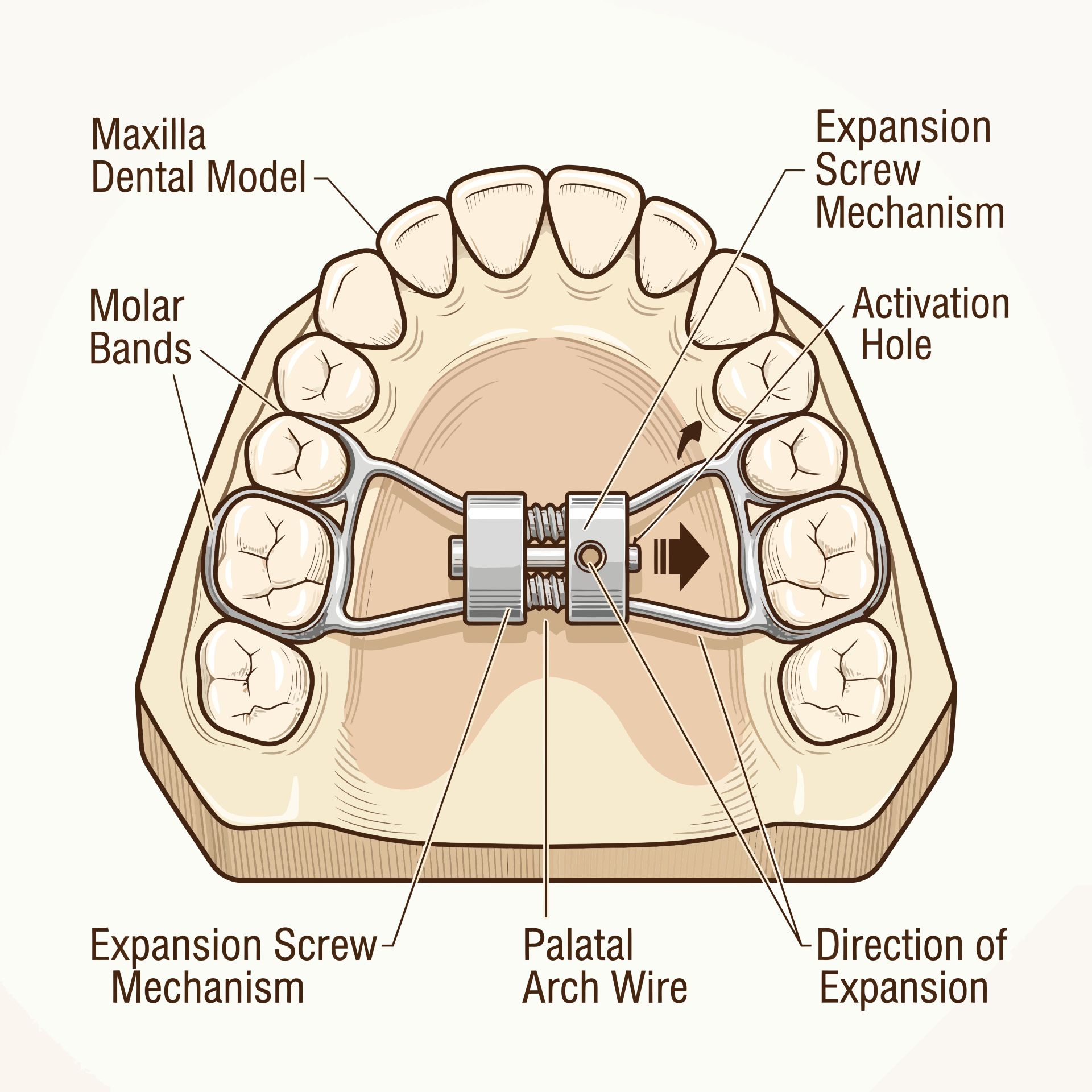
Palate expander vs. braces: what is the difference?
A palatal expander sits across the roof of the mouth and applies force to widen the upper arch. Traditional braces use brackets and wires to move teeth. Both can contribute to correcting a bite, but they are not interchangeable.
| Question | Palate expander | Braces |
|---|---|---|
| Main job | Increase the width of a narrow upper jaw. | Position teeth and improve the bite. |
| A reason it may be considered | A width problem contributing to a crossbite or lack of space. | Teeth that are crowded, crooked, spaced apart or poorly aligned. |
| Does it finish every part of treatment? | No. Tooth alignment may still need attention. | No. Braces alone may not address an underlying jaw-width problem. |
| What determines the plan? | Jaw structure, growth and the expansion needed. | Tooth positions, bite, dental development and treatment goals. |
The American Association of Orthodontists’ expander guide explains widening and its uses. The American Dental Association’s braces guidance describes tooth movement and bite correction.
Why might a child need an expander and braces?
A child may have both a narrow upper jaw and teeth that need repositioning. Expansion addresses the width; braces can then help arrange the teeth within the available space. Completing expansion does not guarantee that later braces will be unnecessary.
Can an expander and braces be used at the same time?
Yes, an expander can be used with braces in an appropriate treatment plan. Other plans use the appliances in sequence. Cleveland Clinic notes that expanders are compatible with braces. Ask your clinician why the proposed sequence suits your child and what each appliance is expected to accomplish.
A helpful way to review the recommendation is to ask for two separate explanations: “What needs to change about the jaw width?” and “What needs to change about the tooth positions?” That makes the purpose of each step easier to follow.
Does crowding always mean a child needs an expander?
No. Crowding is a finding to assess, not an automatic prescription for expansion. The examination needs to establish where space is lacking, how teeth are erupting and how the upper and lower teeth fit together.
The American Academy of Pediatric Dentistry emphasizes diagnosis, dental development and treatment priorities when choosing interventions. Its guidance covers crowding, space management and crossbites rather than treating every developing bite problem the same way. AAPD guidance on developing teeth and bite relationships
Ask whether monitoring or another approach is reasonable, and what the advantages and limits of waiting would be. A photograph of a smile cannot replace the records and examination needed to answer those questions.
When should a child have an orthodontic evaluation?
The American Association of Orthodontists recommends a first orthodontic check by age seven. An evaluation may lead to treatment, periodic monitoring, or no treatment at that time. Age seven is not a deadline for putting an expander in every child’s mouth. AAO guidance on the first orthodontic visit
Growing children and young teens are common candidates for palatal expansion, but skeletal maturity and the actual bite problem matter. An older patient’s options can differ. Read our early orthodontics guide for Albuquerque families for more about evaluation and arch development.
How long does an expander stay in before braces?
There is no single waiting period. Ask about three separate milestones: active expansion, holding the new width while it stabilizes, and tooth alignment. Braces may overlap with part of the process or begin later.
Stopping adjustments does not necessarily mean the expander is ready to come out. The appliance may remain in place to stabilize the result. Your clinician should explain the expected schedule and how progress will be assessed. AAO explanation of expansion and stabilization
Compare complete treatment plans rather than comparing an expander’s wear time with the entire duration of braces. Ask whether a quoted timeline includes monitoring between stages and any later treatment.
What are discomfort and daily care like?
An expander can cause temporary pressure, tenderness, extra saliva or changes in speech. Food can collect around the appliance, so cleaning needs attention. Severe pain or concerning symptoms warrant a call to the treating office. Cleveland Clinic’s expander care information
Braces can also cause temporary soreness and irritation, especially after placement or adjustments. Careful brushing and cleaning between teeth, avoiding foods that can damage the appliance, and keeping follow-up visits are part of treatment. Cleveland Clinic’s braces care guidance
Neither appliance is universally the more painful choice. Ask for a demonstration of cleaning and any prescribed adjustments, written instructions, and a contact number for problems. Do not use an online turning schedule in place of the instructions for your child’s appliance.
What should you ask before agreeing to treatment?
Bring these questions to the consultation so the recommendation covers the whole course of care:
- What is the diagnosis? Ask the clinician to show you the width, tooth-position or bite concern.
- Why treat now? Ask what may change if the problem is monitored instead.
- What will each appliance achieve? Clarify what expansion will leave for braces or another stage.
- Who provides each stage? Ask whether an orthodontic specialist referral is appropriate.
- What does the estimate include? Request details for records, the appliance, visits, retention and any separately billed later treatment.
Confirm orthodontic benefits directly with your insurer, including any age limits or lifetime maximum. A price for an expander alone and a price for a complete treatment plan may cover very different services.